For years, tourism strategy for SEO had a familiar goal: rank high enough, and you’d earn the click.
On paper, the process was simple: A traveler searched “best restaurants in Denver,” Google served a page of results, and then the user clicked the link at the top of the page. For this reason, ranking first was the ultimate goal in SEO, and, for a while at least, it served as a successful organic strategy for DMOs.
Today, travelers are still searching, though the flow has changed. Instead of starting a search within a search engine, users are going to Large-Language Models (LLMs) first. LLMs are highly effective at researching, reasoning, and curating results for users, and the answers are often highly personalized and specifically tailored for engagement. With ChatGPT owning 64% to 68% of LLM market share—and its recent launch of ChatGPT Maps in August of 2026 as a direct competitor to Google—it’s no surprise that search strategies are shifting, with AI experiences often answering questions directly before a user ever needs to click into a website.
Thanks to LLMs, users are also searching in more complex ways, with the average keyword increasing from ~4 words per search term to around 23 words per search as users switch from searching with short strings to searching with detailed, nuanced paragraphs of text. For this reason, optimizing for a simple query like “things to do near me” will not pack the same punch it did several years ago.
Ask Maps: Your Personalized AI Assistant
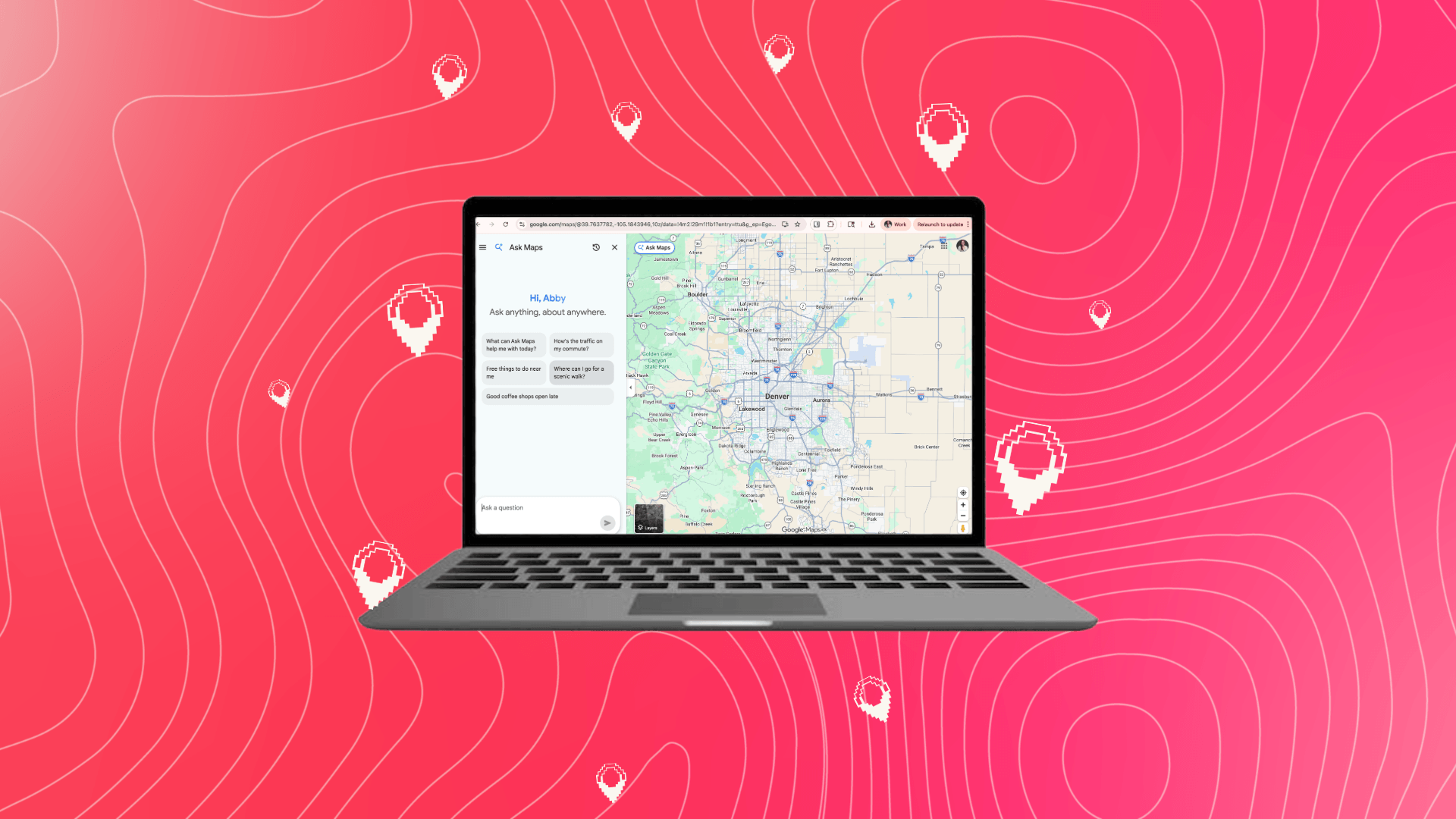
Earlier this year, Google unveiled Ask Maps, a cutting-edge technology that brings conversational AI directly into Google Maps, and gives people another way to ask highly specific questions about where to eat, what to do, where to stay, and what fits their personal preferences.
Now, instead of going to traditional search results, a user can go to Google Maps or ChatGPT Maps, type in “Find a dog-friendly patio near downtown with good vegetarian options,” and browse a list of recommendations personalized to the user. Depending on your digital footprint, Google may even know what type of dog breed you own, tailoring answers for the size and activity of the breed where it makes sense.
In Ask Maps, a user can even search for “Best hiking trails near me,” receive a list of favorite trails near them based on their geolocation, and then follow up with “Where should we eat after our hike?” without ever leaving the conversation and entering a website.
The DMO Role: From Click to Influence
For DMOs, these conversations create a much bigger role for trustworthy local information. While a majority of DMOs are seeing a decrease in web traffic, their role in providing trust and reliability has only grown in importance.
For this reason, what we’re now seeing across DMO search strategies is a widening definition of visibility. To be successful, a page should no longer be measured based purely on its number of clicks. Today, a page can influence discovery even when it isn’t the final page a traveler visits. This changes how tourism organizations should think about the value of their content, especially when it comes to partner listings, events, and local insights provided within editorial.
The next chapter of Google Map SEO is about helping Google understand your community well enough to recommend it.
Google, Search, & More Ways to Discover
SEO has always been about discoverability, with the goal of connecting a person’s question with useful information. And, in many ways, Google’s role of providing answers for searchers has only improved. With LLM-powered experiences like AI Overviews, AI Mode, voice search, and AI assistants, Google is providing users with more ways to get an answer than ever before,and it’s proven to be a successful business model for the search giant.
For tourism marketers wondering how to rank in Google Maps, this changes what visibility can look like.
After all, a traveler may discover a restaurant because it appeared in an AI-generated recommendation, or an attraction showed up in an itinerary because Google found reliable information about its hours, location, reviews, accessibility, or proximity to another stop. Even an event, with crucial Events schema, could surface in Ask Maps while a user is already exploring what to do nearby.
This means that search visibility increasingly depends on whether Google can understand an organization, connect information across sources, and trust what it finds.
And for DMOs, this is where things get really interesting.
Ask Maps Gives DMOs a Natural Advantage
Before LLMs, Google Maps was already popular, with over 2 billion users cited in early 2026. As one of its premier platforms, Google has spent years collecting an enormous amount of information about physical places through Maps and Google Business Profiles: names, addresses, hours, categories, photos, user reviews, locations, websites, and more.
Ask Maps made a great product even greater, adding a conversational layer on top of rich data to create a frictionless experience. Instead of making travelers translate an idea into a handful of search terms, Google can interpret a more detailed request and use available information to find a useful and personalized answer.
The DMO Advantage: Expertise & Authority
For DMOs, one of the most important opportunities comes from something communities already have: firsthand knowledge.
DMO websites contain local business listings, attraction pages, event calendars, neighborhood guides, itineraries, accessibility information, seasonal recommendations, local stories, and years of editorial knowledge.
This information has value beyond website traffic. It can help search systems understand the relationships between places. For instance:
- A restaurant is near a theater.
- A trail works well for families.
- A festival happens every October.
- A museum has free admission on certain days.
- A neighborhood has several independent shops within walking distance.
Those connections are useful to people. Increasingly, they’re useful to machines trying to answer people, too, especially since a German regional court ruled that Google is directly liable for false claims in its AI-generated answers.
Provenance: The Growing SEO Advantage for Verification & Trust
Whether travelers rely on Google Maps or platforms like ChatGPT Maps, AI search creates an unusual challenge for search engines: giving a confident answer is easy, but giving a reliable one? Not so much, especially when some experts predict 90% of all online content will be AI-Generated this year.
AI search creates an unusual challenge for search engines: giving a confident answer is easy, but giving a reliable one? Not so much, especially when some experts predict 52% of all content on the internet is AI-generated.
This means AI provenance matters.
What is AI Provenance?
AI provenance is the ability to track down information to its source. When looking at content to drive its answers, LLMs must build a trust layer based on truth and authenticity. When assessing content, LLMs may attempt to solve questions like, “Where did the information come from? Is it current? Do multiple credible sources agree? Can Google connect a business name with a physical location, website, reviews, and other mentions across the web?”
As well-established authorities, many DMOs have spent years becoming trusted stewards of local information. In AI-powered discovery, this work carries a new weight.
How DMOs Reinforce Authority Online
A well-maintained tourism website gives Google another credible source of information for understanding local businesses, attractions, events, and experiences. Consistent partner information can reinforce the same entities appearing in Google Business Profiles and elsewhere online.
For organizations learning how to rank, authority may increasingly come from connections across a trusted information network.
This means the opportunity is bigger than just ranking your destination. You can also help your partners, local businesses, and local events or attractions become easier to understand, verify, and recommend.
How Your DMO Website Can Strengthen Your Whole Community
A small business owner might reasonably wonder why appearing on a DMO website matters when travelers can get recommendations directly from Google or an AI assistant. Why should a small business owner work with their local DMO?
The answer, it turns out, is because AI is less certain than it appears. Before returning an answer, LLMs like Gemini run a fact-checking technique called Retrieval-Augmented Generation (RAG) that makes sure it’s minimizing hallucinations within its response. For this reason, being accurately represented by a trusted tourism organization like a DMO creates another signal connecting a business with its community, category, location, and offerings.
Consider a local coffee shop (my favorite place in any city I visit). Its Google Business Profile may provide its address, hours, reviews, photos, and a general category. A page dedicated to that same coffee shop on a DMO website adds context about its neighborhood, outdoor seating, signature menu items, nearby attractions, accessibility, or inclusion within a local itinerary. It might even provide additional editorial posts about the owners and employees, and discuss some of the ways the small business is involved in the community.
Now Google has more information to work with when someone asks a detailed question like, “What’s a locally loved breakfast spot near downtown that opens early, and is within a 10-minute walk of the main hotel district?”
This is where Google Maps SEO starts becoming community stewardship.
DMOs can help local businesses create stronger digital footprints by keeping partner information accurate, useful, and connected. More contextual information gives search platforms a clearer picture of a community and the people it represents. It also gives travelers better answers and insights, which means everyone benefits.
How to Rank in Google Maps as AI Changes Local Search
As travelers split their time between Google Maps, ChatGPT Maps, and conversational AI assistants, strong visibility comes from giving search systems clear, consistent, credible information across the places they already look.
Strong visibility comes from giving search systems clear, consistent, credible information across the places they already look.
For DMOs, focus on the 6 following areas to help your partners appear higher in Google Maps and Local SEO.
1. Keep Partner Information Consistent
Start with the basics: Ensure that NAP Signals like business names, addresses, phone numbers, as well as links, operating hours, and other core details match wherever possible across your website, Google Business Profiles, partner sites, and major listings.
Small inconsistencies can make these types of partner relationships harder for AI crawlers and search engines to understand. While clean data might not be glamorous, it’s what helps reinforce clarity for AI crawlers and helps them make the best recommendations for users.
2. Build Intuitive Partner Pages
This is a big one: give users — and search systems — meaningful context that supports the semantic layer of each business.
In other words, include information such as what a business offers, where it is located, nearby landmarks or neighborhoods, accessibility details, useful amenities, seasonal considerations, and links to authoritative sources. To add more firsthand experience, gather quotations from your partners and frequently include them within editorial content.
Good SEO begins with answering real questions clearly, but good AI Strategy continues with unique data and perspectives.
3. Treat Events as Searchable Information
Local events are full of structured details that travelers care about, and AI crawlers are no different: dates, times, locations, prices, performers, parking, organizers, accessibility information, and nearby experiences.
Help AI crawlers by keeping event calendars current and make individual event pages easy for search engines to crawl and understand. AI understands the page’s content using many signals, some of which being:
- Clear, structured formatting (date, time, location, and category)
- Descriptive titles and summaries
- Dedicated, indexable, single-entity pages
- Helpful internal links from relevant guides or location pages
As search agents and AI recommendations become more common, current event information gives those systems something useful to find, especially as AI agents rely on information not available within their training sets.
4. Write for Specific Questions
Despite the growing advancements in search, traditional keyword research still matters as a signal. The biggest shift is search behavior as it becomes more conversational, with Google adapting query fan-out to split a single search into multiple, related searches to form a complete and comprehensive answer. Thanks to
Build content around the way a visitor actually talks. Instead of creating another broad “Things to do” page, answer questions like:
- What are the best rainy-day activities for families?
- Which restaurants are open late near downtown?
- Where can visitors find accessible hiking trails?
- Which local businesses are within walking distance of a major attraction?
This approach supports fundamental SEO best practices while creating clear context for AI-generated answers.
It’s also a more useful way to think about how to get found online in the age of AI. Answer the questions people ask once they are already thinking about going somewhere.
5. Add Structured Data Where it Helps
For DMOs, structured data should be treated as a foundational layer of Google Maps SEO and broader SEO strategy, especially as Google rolls out data-sharing initiatives like Open Knowledge Format. At minimum, teams should evaluate implementation across key content types including Local Businesses (for partners and attractions), Events (for festivals, performances, and seasonal programming), Organizations (for the DMO itself), and Article or Tourist Attraction where appropriate.
Breadcrumb markup also plays an important role in clarifying site hierarchy, especially for large destination sites with layered geography (region → city → neighborhood → experience).
In the context of Ask Maps and AI-driven discovery, schema becomes even more important because it reduces ambiguity. When Google is interpreting conversational queries like “family-friendly things to do near downtown with indoor options,” it benefits from clearly labeled attributes such as location, category, accessibility, price range, and event timing. Structured data helps reinforce those attributes in a way that is consistent with how AI systems parse and recombine information.
That said, schema is not a visibility strategy on its own (and some SEOs argue schema does not meaningfully affect the ability of a page to rank). Schema does not create authority, and it does not compensate for thin, outdated, or inconsistent content. Schema’s value is in reinforcement: it strengthens the signals already present in well-maintained pages, accurate partner listings, and high-quality editorial content. Fortunately, with the help of LLMs, it’s easier than ever to automate schema at scale for your website, especially if driven by an AI-savvy development team.
6. Connect the Dots Across Your Content
So many DMOs often have all the pieces of success on their website, ready to go, but do not follow through by reinforcing content with inlinks. A restaurant listing should connect naturally to relevant neighborhood guides. An event can link to its venue. An itinerary can reference attractions, businesses, and supporting editorial content.
Internal links help visitors move through your site while helping search engines understand relationships among entities.
Google is built around relationships in the physical world. Your website should make those relationships clear digitally.
SEO and GEO Are the Same Conversation
With LLMs seemingly taking over the Internet, do you still even need SEO? According to Google, yes. Remember from earlier, SEO is discoverability. Generative engine optimization (GEO) and answer engine optimization (AEO) sometimes gets discussed as a replacement for SEO, but it’s all part of the same playbook.
Good SEO makes information discoverable. Good GEO makes information understandable, credible, and useful enough to inform and answer and inspire action.
There’s plenty of overlap: clear site architecture, strong local expertise, firsthand knowledge, consistent information, helpful headings, structured data, reliable sources, and current content.
All of these practices help people understand your community while giving search engines and AI systems better information to work with.
So when a DMO asks us how to rank in Google Maps in an AI-powered search environment, our answer starts with the same principle we bring to community storytelling:
Start with what’s true. Then make that truth easy to find.
Here’s What You Should Start Today For Google Maps SEO
If you only do three things this quarter, start here:
- Audit your highest-value partner listings. Check business name, address, URL, hours, category and important attributes against Google Business Profiles.
- Add context Google can’t get from an address. Connect businesses to neighborhoods, nearby attractions, traveler needs, accessibility information and relevant itineraries.
- Build content around real traveler questions. Use Search Console data, on-site search, visitor center questions and partner conversations to identify what questions people actually want answers to.
DMOs Are the Source AI Trusts
Communities already contain the information travelers want. The best breakfast locals line up for. The overlook that’s worth reaching before sunset. The annual festival everyone plans around.
Strong SEO gives search engines clean information. Strong editorial content adds context. Structured data helps machines make sense of it all. Accurate partner listings strengthen local visibility. Firsthand knowledge gives the whole system something credible to work from.
To us at KHM, the goal is bigger than figuring out how to rank in Google Maps. Help search engines understand your community well enough to represent it authentically. Help local businesses become easier to discover. Help travelers get better answers on the road.
Trust has always mattered in tourism. AI search is beginning to make that trust measurable. If there’s one thing to take away from all of this, it’s that DMOs aren’t only marketing their communities anymore. They’re helping machines understand them.
FAQs
- What is Google Ask Maps?
- Google Ask Maps is a conversational AI feature within Google Maps that allows travelers to ask specific, detailed questions to find personalized recommendations for dining, activities, and lodging.
- How can DMOs improve their Google Map SEO?
- DMOs can enhance Google Map SEO by maintaining consistent partner information, building intuitive local business pages, and using structured data to help search engines understand relationships between local entities.
- How do you rank in Google maps in the era of AI Search?
- To rank in Google Maps today, focus on building trust through credible, firsthand local knowledge and ensuring your website provides clear, consistent signals that search platforms can verify across the web.
- Why is Ask Maps important for DMOs and local tourism?
- Ask Maps shifts search from keywords to conversations, making it essential for DMOs to provide context-rich content that helps AI systems recommend specific local businesses based on detailed user preferences.